|
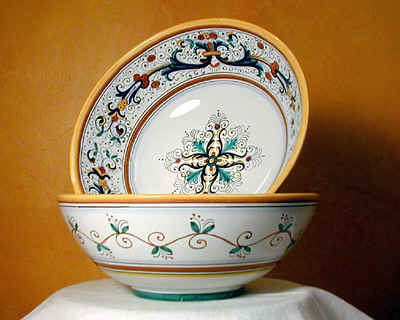
Deruta in Umbria, Italy, is one of the most famous centres for ceramics and chinaware production in Italy. Visitors to Deruta who are interested in hand-painted pottery and other ceramics won't be disappointed. Here we offer a guide to the principle styles or Deruta ceramics. Although some of the best Italian majolica was produced between 1440 and 1540, the characteristic ceramic styles of Deruta, outlined below, reached their highest levels of development in the early 16 C. These styles are now widely copied in other Italian ceramics centres but the best examples are still produced in Deruta and there are numerous shops offering a wide range of Derutaware at competitive prices. Much of the ceramics production is carried out as a cottage industry, with unbaked clay plates, bowls and other objects being brought in to the ovens to be baked and then taken away again to be hand-painted, before being brought back once more for glazing. This means that the artistic quality of the decoration varies and it is well worth your while to visit as many shops as possible to compare similar items before making your final purchase.
Deruta is rated one of the most beautiful villages in Italy,
|
|||||||||||||||||||||||||||||||||||||||||||||||||||

|
||||||||||||||||||||||||||||
)
Deruta
Deruta ceramics styles
Deruta RaffaellescoThe birth and and name of this style can be traced back to Raphael (Raffaello Sanzio. He habitually adorned the borders of his frescoes with symbolic decorations depicting dragons and mythical animals. The craftsmen of the late 16 C copied and adapted these decorations from the engravings of contemporary artists, giving rise to one of the most famous Deruta styles. Today Deruta is still widely identified with this style. |
|
)
Ricco Deruta
)
|
)
|
Its origins, as for the Raffaellesco, date back to the Renaissance period. The painters of that time commonly copied the decorations of great contemporary artists, such as Raphael and his master Pietro Vannucci called the Perugino. We can identify the bloomed scrolls and the blue arabesque characterising this style in the frescoes of these two artists.
Deruta Arabesco
a very common style, derived from the patterns on ware imported from the east in the 15 C.
) |
) |
|

History of Deruta
The origins of the town of Deruta are for the most part obscure. It has always had important links to Perugia, which acts as a powerful bastion to the south and with Todi, another fortified town further south towards Rome.
During the 13 C Deruta had its own statutes, followed in 1465 by a new document written in the vernacular which mandated the presence in the castle of four "boni omini", elected by and from among the residents, in addition to the podestà delegated from Perugia. In the second half of the 15 C, the residents were decimated by plague, and the city walls collapsed through lack of maintenance. In addition, during the "Guerra del Sale" (1540), Deruta, which had aligned itself against the Pope, was attacked and devastated. However, the submission of Perugia to the Church also brought a long period of peace to Deruta. During these years of peace, Deruta became famous for the high quality of its majolica.
Sights of Deruta
Early furnaces are evident as one enters the historical centre of Deruta through the Porta di S. Michele Arcangelo. In the small Piazza Biordo Michelotti one may view the sober lines of the gotho-romanesque church of S. Arcangelo, in front of which there is a fine polygonal fountain dating from 1848.
)
Piazza Biordo Michelotti
Next is Piazza dei Consoli, where the Palazzetto Municipale,
dating from 1300, is located. Its atrium houses a collection of
neolithic and Etruscan archaeological finds. The Palazzo houses, in addition, the
Pinacoteca and the Museum of Ceramics. The Pinacoteca contains an important collection of paintings originating from the churches of S. Francesco, S. Antonio, the Defunti di
Ripabianca and the hospital of S. Giacomo, and also a part from the rich collection of Lione
Pascoli. Paintings of the Alunno, the Baciccio, Stendardo, Amorosi, Fiorenzo di Lorenzo and Guido
Reni are on display. The Museum of Ceramics houses a magnificent display
of ceramic works of art from archaic to modern times.
In front of the Palazzo Municipale is the gothic Church of S. Francesco.
The former Franciscan convent with its ancient cloister is located
adjacent to the Church. At the end of the narrow Strada Mastro Giorgio rises the
Church of S. Antonio which preserves important frescoes by Bartolomeo and Gian Battista
Caporali. The small church of Madonna del Divino Amore, today known as
Madonna della Cerasa is situated at the top end of Piazza Cavour. Along the Tiberina road one sees the small
church of Madonna delle Piagge
dating from 1601, the facade of which is adorned with beautiful maiolica. Close by to this church one may visit an interesting
Majolica Museum.
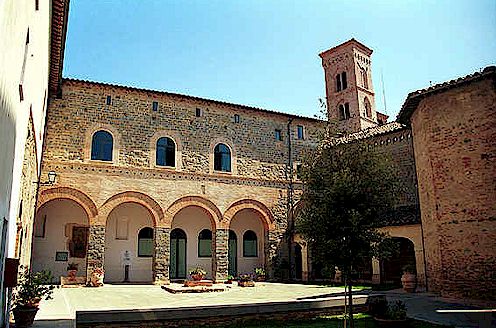
Deruta ceramics museum
)
|
)
|
)
|
Antique Deruta majolica
Other Tuscan ceramics sources
www.montelupo.com Montelupo
Fiorentino, the historic centre of Tuscan hand-painted ceramics
|
|